Léon Foucault
French Explorer of Light and Motion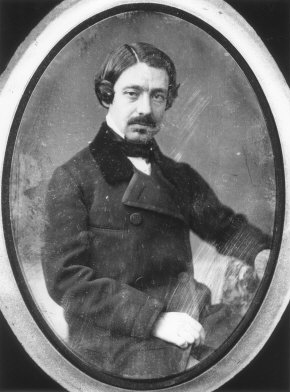
Léon Foucault in the 1840s (This is One of the First Daguerreotypes of a Person Ever Taken)
20-Year Old Léon Foucault in 1840
Hippolyte Fizeau, a Childhood Friend who Collaborated with Foucault Early in His Study of Light
The First Photograph (i.e., Daguerreotype) Ever Taken of the Sun (taken by Foucault and Fizeau in 1845)
Louis-Jacques-Mandé Daguerre, Inventor of the Daguerreotype Process of Photography
A Drawing of One of Foucault's Heliostat's Used to Observe the Sun (and help take the photo above). The Mirror (top left) Reflects the Sun's Light Towards a Wall, while the Rest of the Heliostat Allows the Mirror to Follow the Movement of the Sun in the Sky (and Keep the Projected Image of the Sun Stationary on the Wall).
François Arago, a French Mathematician, Physicist, and Astronomer who Greatly Helped Foucault (particularly in early career)
Foucault's Spinning Mirror Device in His Experiments on Light
A Highly Simplified Drawing Showing Foucault's Experiment on the Wave/Particle Question of Light; When Foucault Conducted His Experiment, the Light Beam Appeared in the Location Predicted by the Wave Theory
Foucault's Pendulum at the Pantheon in Paris, France
Animation of Foucault's Pendulum, with the Earth's Rotation Greatly Exaggerated. The Green Trace Shows the Path of the Pendulum Bob over the Ground, while the Blue Trace Shows the Path in a Frame of Reference Rotating with the Plane of the Pendulum.
Video Demonstration of Foucault's Pendulum
The Bob of Foucault's Pendulum at the Pantheon in Paris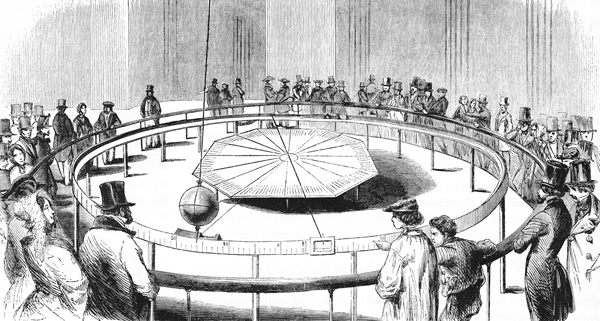
Engraving of Foucault's Pendulum Experiment at the Pantheon in Paris (1851). This Engraving was Published in L'Illustration on April 5, 1851. The Artist has Exaggerated the Size of the Bob for Effect
Foucault's Sine Law. Foucault Derived this Equation, the First of Its Kind, to Explain the Time (T) in Hours that it Takes for a Pendulum to Complete a Full Circle Due to the Earth's Rotation at a Given Latitude ɵ. For example, in Paris, the latitude is roughly 48 degrees, 51 minutes, north. Plug that into the equation for the variable ɵ and you find out that it takes approximately 32 hours for the pendulum to make a full circle (entering the exact latitude will give you the exact time). Also, note that at the north pole, the latitude is 90 degrees; the sine of 90 degrees is one, so it takes exactly 24 hours for the pendulum to make a complete circle at the north pole. Conversely, at the equator, the latitude is 0 degrees; the sine of 0 degrees is zero, so it takes an "infinite" amount of time for the pendulum to make a full circle (the pendulum's plane of oscillation does not change at all).
Foucault's 80-cm Telescope Constructed in 1859 in Paris
Main Components of a Gyroscope
A Highly Exaggerated Simulation of a Gyroscope Demonstrating the Rotation of the Earth; The Rotation of the Earth Makes if Appear as if the Axis is Spinning in a Circular Path; In fact, the Axis is Not Changing Position at All -- The Earth is Changing Position! Foucault Needed to Use a Microscope to Show the Circular Motion of the Axis Shown in this Simulation
Foucault's Gyroscope, Invented in 1852. This is a Replica Made for the World Exposition in 1867
Video Explaining How a Gyroscope Works
This Computer Simulation Shows How the Pin of the Gyroscope Appears to Move; Actually, the Pin isn't Moving at All; the Earth is Moving (i.e., Rotating)
Buzz Aldrin Explains How a Gyroscope Works on His Return From the Moon Aboard the Apollo 11 Return Module
Steve Jobs Introducing the Gyroscope Feature in the iPhone 4
If You Want to Learn the Physics Behind the Gyroscope, This is an Excellent Lecture
Device that Foucault Built in 1855 to Demonstrate that Mechanical Energy Can Be Converted into Heat. Cranking the Handle Spins the Copper Disc Between the Poles of the Electromagnet; This Induces Currents in the Disc, Causing It to Heat Up
Foucault's Spinning Mirror that He Used in 1862 for the First Accurate Laboratory Measurement of the Speed of Light and Distance to the Sun
The Clock-Driven Timing Wheel Foucault Used in 1862 to Determine the Speed of the Spinning Mirror Stroboscopically
Portrait of Léon Foucault Later in Life
Léon Foucault's Grave, Cimetière de Montmartre, Paris, France